Understand your requirement
Describe hazardous movements, the actual pallet route, load variations and possible access beside or behind a load. Record operator, cleaning, blockage and maintenance tasks separately from the normal automatic transfer.
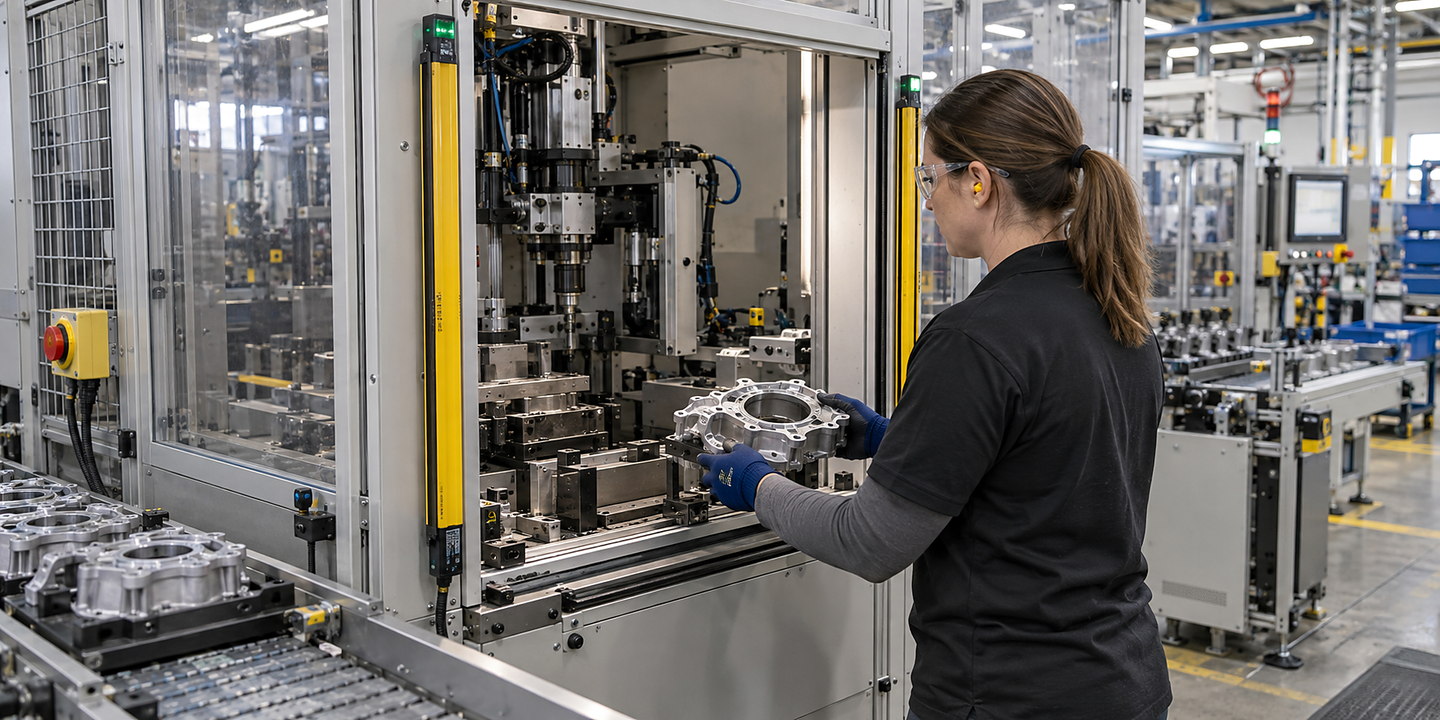
Compare pallet-transfer safeguarding concepts against the same load range, foreseeable access, protective functions, control interfaces, fault response and validation evidence. Keep personnel access separate from automatic transfer.
Compare safeguarding concepts against the same hazards, pallet/load range and foreseeable access routes. Require the proposed material-recognition and muting sequence to be explained with its termination, fault and recovery conditions. Assess the complete transfer opening and machine functions, including how personnel access is prevented or controlled.
Prepare the safeguarding comparison brief and validation scope. Existing pictures provide general guarding context; they do not demonstrate a functioning pallet-muting sequence or certify a safe installation.
Plan pallet muting systems around your machine hazards, operator tasks, access, stopping behaviour and validation evidence. Discuss a site-specific safeguarding concept with Oxford Machine Guarding. When you compare solutions, check how each option handles hazards and foreseeable access for safeguarded pallet-transfer muting, machine motion and stopping behaviour and your surrounding line.
Discuss your application

Describe hazardous movements, the actual pallet route, load variations and possible access beside or behind a load. Record operator, cleaning, blockage and maintenance tasks separately from the normal automatic transfer.
Compare how each proposal controls foreseeable access while permitting the defined material movement. Require an explanation of recognition, sequence, reinstatement of protection, abnormal conditions and any separate personnel-access arrangement.
Coordinate the physical transfer opening, surrounding guarding, protective device, stopping functions and safety-related control interfaces. Have geometry, access and reset or recovery visibility assessed for the complete installed machine.
Agree competent validation using the approved safe method, retained configuration and expected-versus-observed results. Include normal and credible abnormal conditions and keep unresolved actions visible before the responsible acceptance decision.
Typical support: site survey, risk-led guard design, manufacture, installation and validation within an agreed scope.
| Approach | Often suitable when | Watch for |
|---|---|---|
| Pallet Muting Systems | You need a dedicated solution for a clearly defined duty, product or part range and line interface. | Current standards and required performance levels must be assessed for the complete machine and intended use. |
| Fixed Physical Guarding where Access Is Rare | Your volumes, product mix or operator judgement make a simpler route more practical. | Check ergonomics, consistency and safe access before choosing the lower-complexity option. |
| Interlocked or Presence-Sensing Protection where Frequent Intervention Is Foreseeable | Your surrounding process is stable enough for a broader automated solution to add value. | Allow for line connections, fault recovery and maintenance as well as the headline equipment. |